

Protecting Participation in Civic Life

For the Catholic Church, participation in civic life is not merely a political act but a matter of human dignity and the common good. The importance of election participation has deep roots in Catholic social thought, from St. Thomas Aquinas to modern magisterial teachings.
This aspect of our current work is rooted in principles of Catholic Social Teaching, protecting the dignity of all God’s people through the affirmation of their voting rights, and the ability for each person to answer the call to community and participation in their civic responsibilities.
In moments of weakening democratic norms, the Catholic Church has an inspiring history across the globe as being an essential force for safeguarding and enabling democracy.
3 Ways to Get Involved:
Build Support
Recruit community and institutional leaders to virtual theological conferences. Consider hosting a watch party in your community!
Engage Your Community
Use the Protecting Participation in Civic Life Workbook to
Talk about election safety and faithful citizenship with your ministry, community or leaders
Meet with local election officials
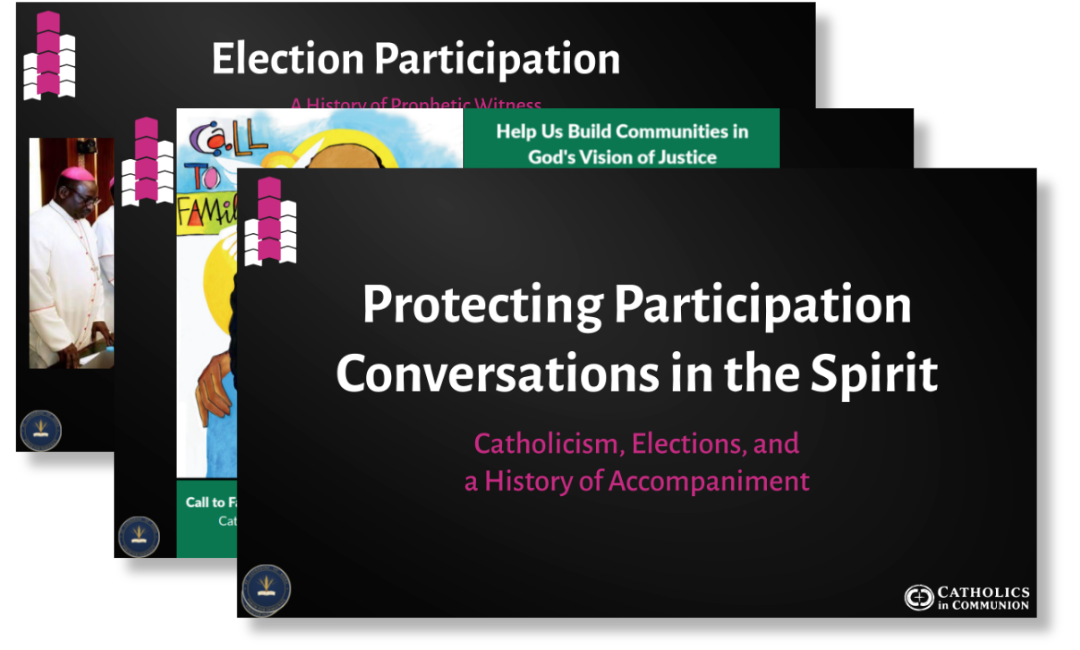
Use the Protecting Participation Conversation in the Spirit presentation and facilitator guide to host a discussion
Make a Plan for Voting in Communion
Prepare for public witness and ongoing support on and after election day. A few ideas:
Host voter education or registration on “Voting in Communion Sundays”
Invite an election official you have met with to a community event
Organizing group rides to the polls
Invite people to bring their mail-in ballot to church - “Bless the Ballots”
Recruit 30 poll chaplains - can be clergy or lay folk
What does our Church teach about democracy and civic life?
The United States norms and understanding of democracy is grounded in great Catholic Theologians. St. Thomas Aquina in Summa Theologica supported a mixed constitution including “government by the people, in so far as the rulers can be chosen from the people, and the people have the right to choose their rulers. (Summa Theologica Q105)
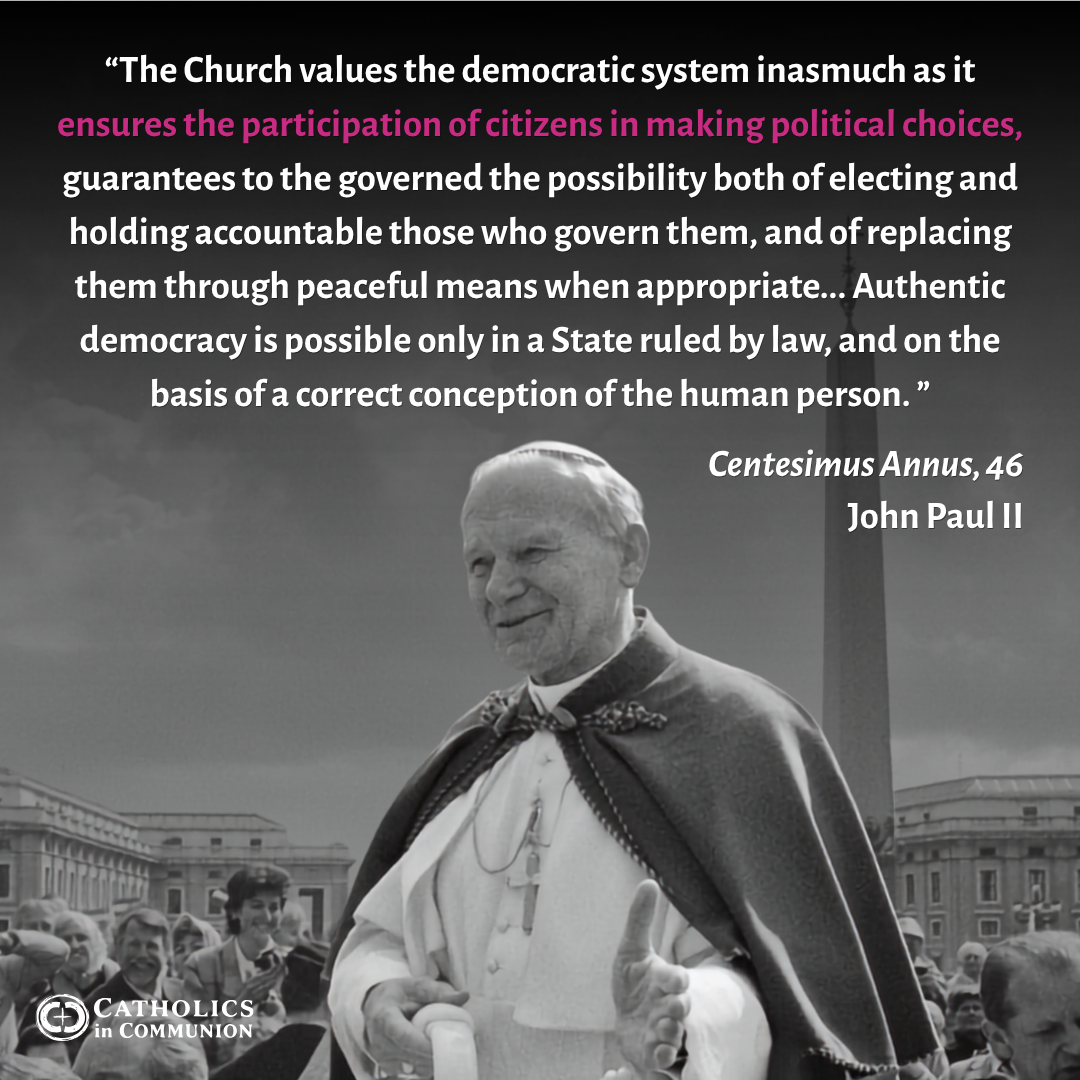
The Compendium of the Social Doctrine of the Church ( 408) says this about institutions and democracy: “The Magisterium recognizes the validity of the principle concerning the division of powers in a State: “it is preferable that each power be balanced by other powers and by other spheres of responsibility which keep it within proper bounds. This is the principle of the ‘rule of law', in which the law is sovereign, and not the arbitrary will of individuals”.
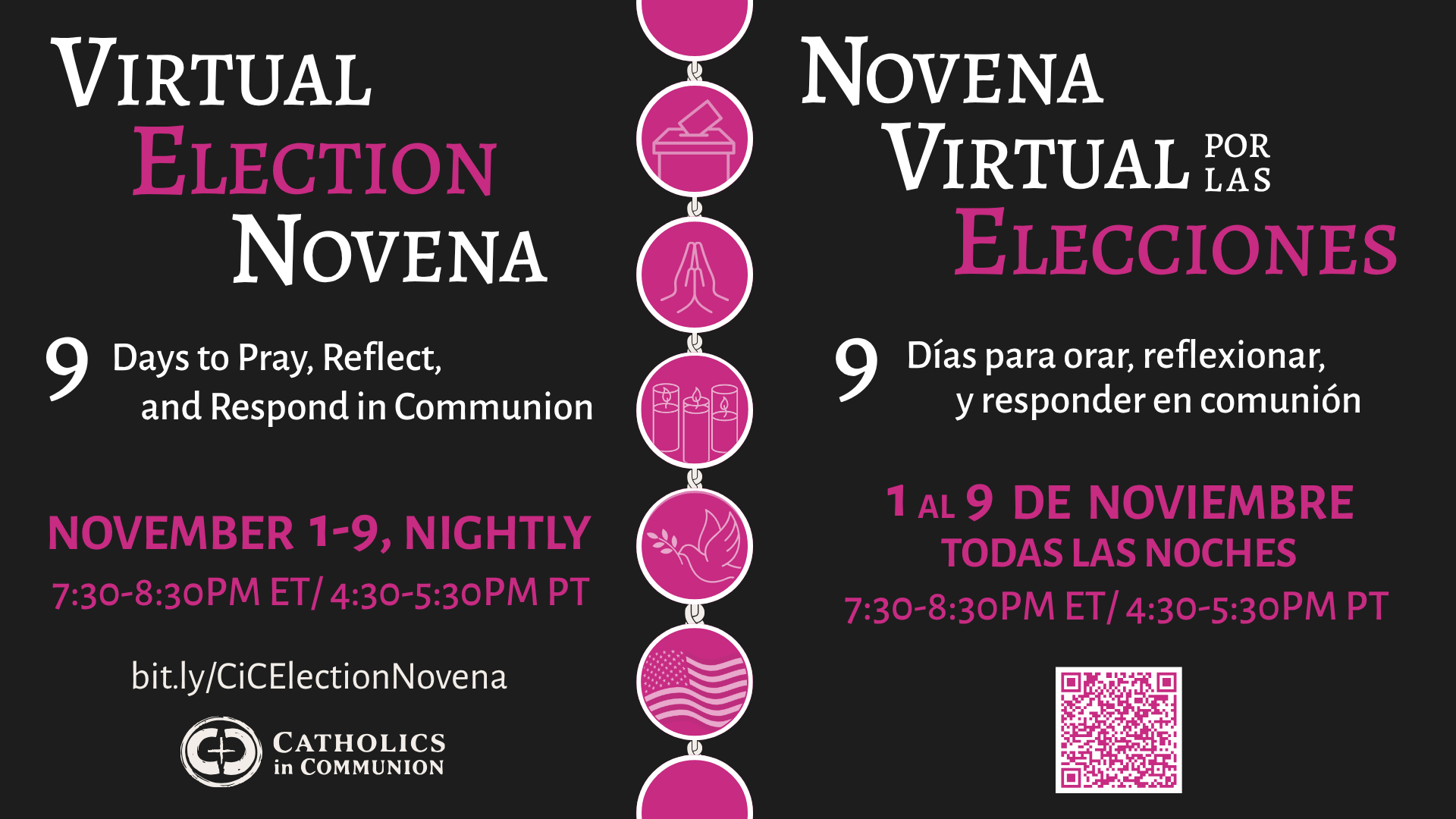
Virtual Election Novena
9 Days to Pray, Reflect, and Respond in Communion
Join our community on Zoom for:
USCCB’s Novena for Faithful Citizenship
Shared prayer and featured speakers
Latest election updates and opportunities to protect participation
Why now? What’s at stake for the people we love in this election?
Bishops Perry and Garcia have recently written “ Catholic solidarity requires us to uphold the sacred dignity of every person and to speak boldly whenever justice is at stake — especially when the rights of historically marginalized communities are placed at risk. Solidarity is not passive; it calls us to attentiveness, accompaniment and moral resolve.”
Human Rights Watch's 2026 World Report says democracy is now back to roughly 1985 levels by some metrics, with about 72% of the world's population living under autocracy.
In the US, redistricting in many states has decreased the power of citizens to participate meaningfully in elections.
“Today, many communities of color worry about how recent will impact their fair representation and future participation in the democratic process. Echoing our Holy Father, Pope Leo XIV, we affirm the value of democracy ‘insofar as it guarantees the effective participation of citizens’ as a reflection of their dignity. For decades, the U.S. bishops have advocated for the right of eligible citizens to participate fully in public life, including the protection of voting rights. ” (Bishop Daniel E. Garcia, chairman of the U.S. Conference of Catholic Bishops’ Subcommittee for the Promotion of Racial Justice and Reconciliation)
The US Department of Justice has sued 23 states for refusing to hand over voter rolls
The current push by the administration to pass the SAVE (Safeguard American Voter Eligibility) Act would make voter registration and participation more difficult