
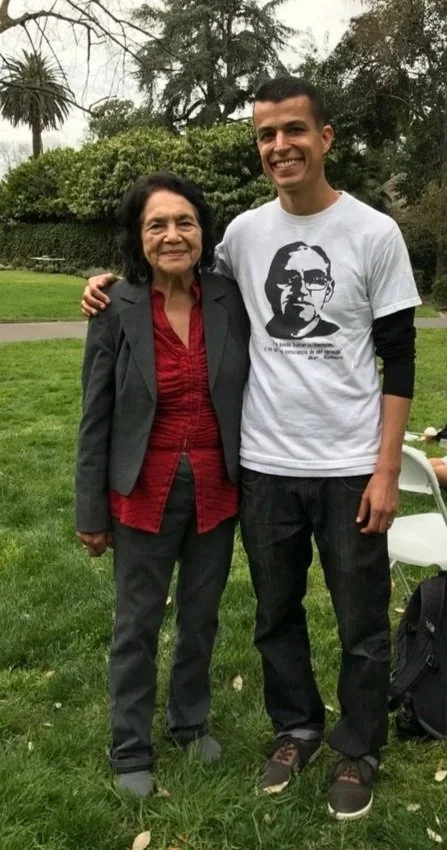
This picture captures one of my favorite memories with Dolores: March 2017, on the lawn of the State Capitol, after a PICO California and coalition action for SB 54, the California Values Act, to protect immigrant families by stopping collusion between ICE and local law enforcement. “You are doing the Lord's work,” she told me afterward. “¡NO te rindas!” (“Don’t you EVER give up!”)
Her message to us was often a mix of righteous indignation, hope, and endurance. St. Augustine once said that “Hope has two beautiful daughters; their names are Anger and Courage. Anger at the way things are, and Courage to see that they do not remain as they are.” Dolores is one of hope’s beautiful daughters.
Dolores had the ear of mayors, legislators, governors, and presidents. Many sought her favor. But her heart was always with the people. She never let herself become a figurehead. Her understanding of organizing, of what it takes to make change, required closeness to everyday people and their messy, beautiful struggle for a more just world. Her actions, even more than her words, embodied a relentless belief that together we could overcome the lie that some lives matter less than others.
Dolores always pushed me on the contradictions of the Church. She would reminisce about earlier generations of clergy and people of faith, like Monsignor George Higgins and Bishop Joseph Donnelly, who marched prophetically and courageously with the farmworkers.
A pastor I organized with years ago in New York City, Monsignor Fernando Ferrarese, once told me that the most formative experience of his seminary years didn’t happen in a theology class. It happened outside a supermarket in Brooklyn, where he and his fellow seminarians held a boycott action. They asked shoppers not to buy table grapes from growers who mistreated farmworkers. Standing there in solidarity with Dolores and the farmworkers, as an expression of faith in a compassionate and loving God, changed his life and the direction of his ministry. Dolores influenced countless lives like his.
And she would often ask me some version of: “Where are the bishops and clergy today? Social justice isn’t a trend you wear for a season and then put back in the drawer.” Dolores challenged our institutions, and each of us, to practice what we preach: to close the distance between our words and our deeds, and to more fully embody the values we hold sacred.
I give thanks to God for the gift of her life and example. Her spirit will endure through our organizing, and her commitment to the peripheries will keep renewing our sense of mission.
I can hear her voice now, leading the call and response she led so many times at community actions:
“Who’s got the power? We got the power! What kind of power? People power!”
Dolores gave her life to the promise and potential of people power. May that belief inspire our struggle for human dignity and the common good. May her spirit give us the endurance never to give up.
Dolores Huerta, ¡presente!